

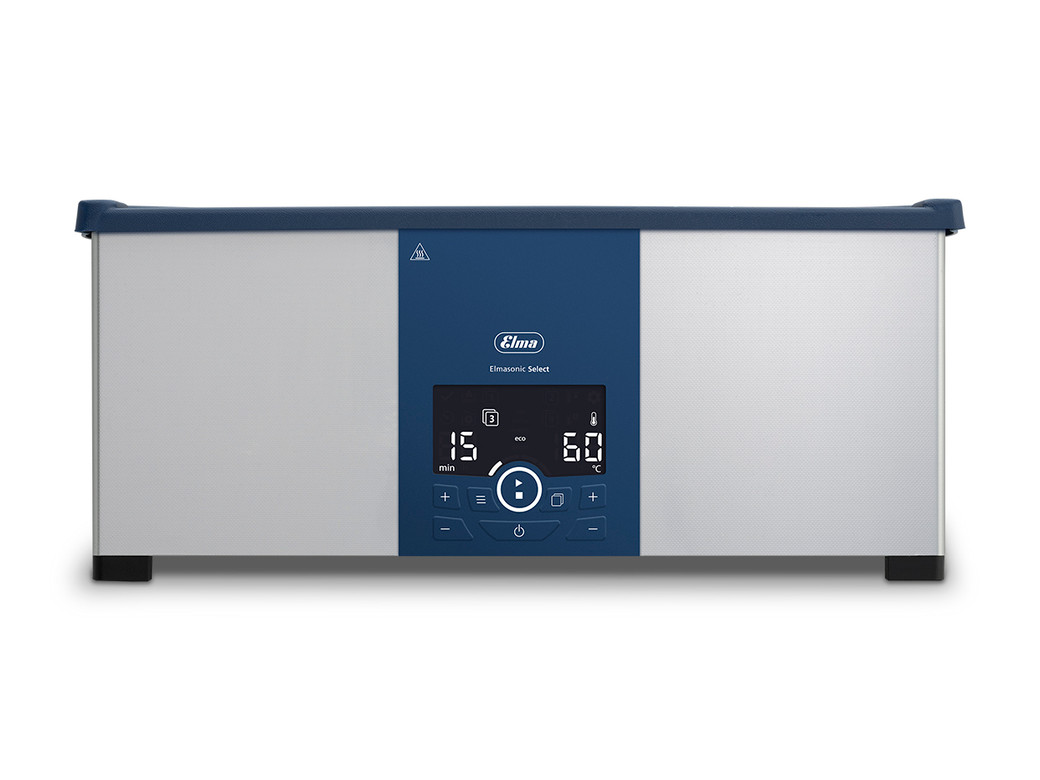
In the pharmaceutical, cosmetic and food processing industries ultrasonic cleaners are employed as sonicator baths for sample preparation for analytical testing. Unlike cleaning medical devices, when using an ultrasonic bath to prepare samples,the analytical method that uses ultrasound is validated, not the equipment. Guidelines include ICH Q2(R1), procedures for validating analytical methods, and USP 1225, validating accepted standard procedures. The ultrasonic bath does, however, need to be qualified through IQ/OQ/PQ like any lab support equipment.
Summing it Up
When an analytical method employs a sonicator bath (for particle dispersing or sample extraction as examples) CGMP requires accuracy (does sonication extract 98–102% of the API?), precision (do multiple samples agree with a required standard deviation [RSD] demonstrating reproducibility), linearity (is extraction proportional across concentration) and robustness (accommodating slight variations in time, temperature and sample positions).
If the validated analytical method gives accurate, precise, and robust results using sonication at a defined location in the bath, this means the ultrasonic cleaner is fully qualified.This approach indirectly answers “yes” to “does the sample get prepared correctly every time?”
A Qualifying Exercise for an Ultrasonic Cleaner
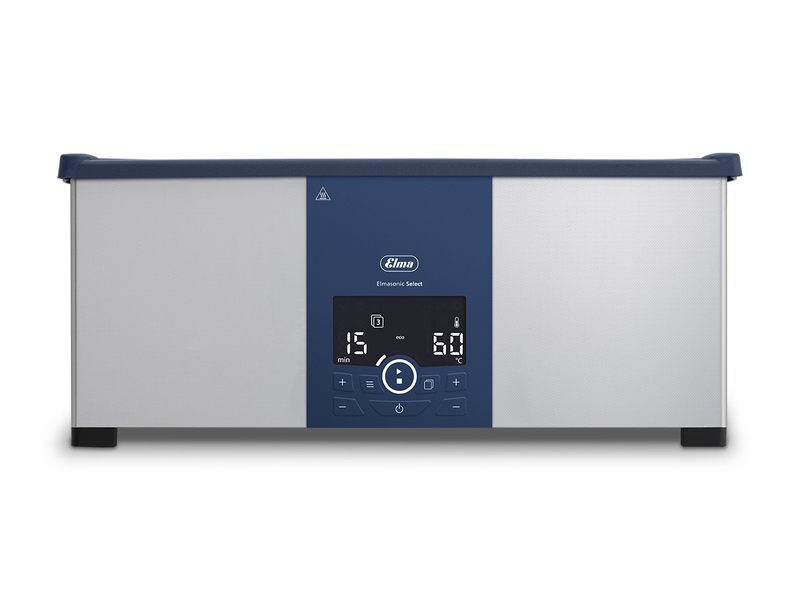
Here’s an exercise using the 3.9-gallon Elmasonic Select 150 with tank dimensions 19.9 x. 11.8 x 3.9 inches (l, w, d). This unit is ideally suited for USP methods that specify an ultrasonic bath for sample preparation. That’s because its shallow depth concentrates its 300 watts of effective ultrasonic power to speed sample prep time. This helps avoid heat buildup that can cause API degradation.
Installation Qualification (IQ)Criteria Include
- Equipment serial number
- Size or capacity of unit including volume and dimensions
- Supplied utilities (i.e. power, water, drainage, ventilation…)
- Installation conforms to operation/maintenance manual requirements
Operation Qualification (OQ) Verifies
- Bath Temperature Accuracy by using an NIST-certified thermometer against a ± standard
- Timer Accuracy by using an NIST-calibrated timer against a ± standard
- Ultrasound turns on
- Safety Features – include high-temperature alarms, auto shutoff
- Sample Positioning. Because ultrasonic cleaners do not deliver energy equally throughout the bath sample placement becomes an important OQ criterion
What regulators look for
- identify the sample container (vial, flask, test tube)
- determine its location in the bath
- establishing water level in the bath
- fixing process time and temperature
For example, a validated method could read: “Place the 20 mL flask in the center of a 37 kHz ultrasonic bath at 40⁰C and sonicate for 15 ± 1 min.”
Performance Qualification (PQ)
This proves the ultrasonic cleaner delivers consistent results when
- extracting samples from tablets or residues
- dissolving a poorly soluble API standard
- accommodating multiple preparations in a single cycle
Regulators will look at what is being tested, that multiple tests yield the same analytical result, that recovery is correct, that the relative standard deviation (RSD) is within limits, and the process can withstand slight variations in time and temperature.
- Pro Tip: Select suitable accessories that fix samples in position in the bath. A wide variety of sample supports are available for Elmasonic models, including flask clamps, test tube racks, side combs, bottom combs, and more. (Add a small amount of surfactant to the water in the tank to improve bath performance.)
- Pro Tip: Be certain the ultrasonic cleaner tank is filled to the fill line. Overfilled or underfilled tanks yield inconsistent results. Allow for solution displacement by sample containers. To treat small samples in a deep tank do not underfill the tank, instead use basket levels which raise the bottom of the basket.
A Word of Caution: Do Not Deviate
It is absolutely essential that all future applications for your validated ultrasonic sample-preparation operations conform exactly to procedures employed to achieve the successful results. Document and record them as part of your organization’s Standard Operating Procedures. Establish a Best Practices Protocol that includes record keeping for each exercise.
Additional Resources
Here is some additional reading that relates to applications where results employing ultrasonic energy can be critical:
- Sonication Baths for Sample Preparation delivers additional information on the process including alternative ultrasonic cleaners that can handle more difficult samples or provide deeper immersion in the bath.
- Laboratory Applications for Ultrasonic Cleaning describes how ultrasonic cleaners are employed in cleaning laboratory equipment and sample preparation exercises (Scroll to “Beyond Cleaning”).
- A Laboratory Sonicator Guide expands on the many ways ultrasonic cleaners are used in pharmaceutical, food and cosmetic industries and how to maximize your sonicator investment.
- Understanding IQ, OQ, and PQ: The Validation Life Cycle provides a broader look at IQ, OQ and PQ across many disciplines.
Need More Info on Qualifying your Sonicator Bath?
The scientists at Tovatech welcome your inquiries and make themselves available to provide unbiased information on equipment selection, process validation procedures and other vital aspects relating to this topic.
Contact a Tovatech Scientist Today!