

Validating Ultrasonic Cleaners in a CGMP Environment
Ultrasonic cleaners play critical roles as tools to clean small parts such as pumps, valves and filters used in drug development and manufacturing. As such, ultrasonic cleaners can be validated in CGMP environments and in Title 21 of the Code of Federal Regulations as a processing tool delivering energy, called cavitation, to clean equipment. This means CGMP requires demonstrated cleaning effectiveness under validated conditions and calls for measuring, checking and recording the unit’s specifications and performance under validated conditions using calibrated instrumentation.
When used in cleaning applications
- An ultrasonic cleaner is CGMP compliant when it performs as advertised, and
- The cleaning results can be validated using accepted measurements and procedures
A Compliance/Validation Exercise for an Ultrasonic Cleaner
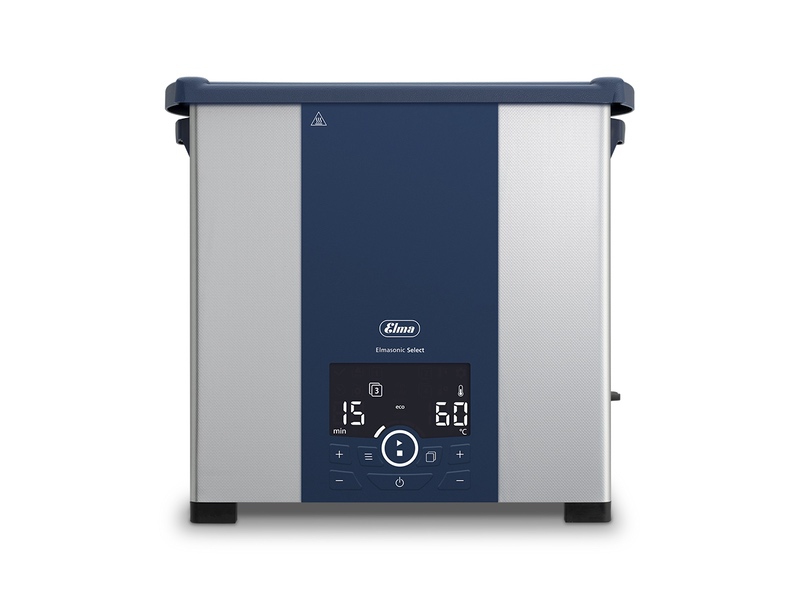
CGMP requires demonstrated cleaning effectiveness under validated conditions. Here’s an exercise using the 3.4-gallon Elmasonic Select 120 with tank dimensions 11.8 x 9.4 x 7.9 inches (l, w, d) and recommended basket dimensions 9.8 x 7.7 x 5.3 inches.
Installation Qualification (IQ) Criteria Include
- Equipment serial number
- Size or capacity of unit including volume and dimensions
- Supplied utilities (i.e. power, water, drainage, ventilation…)
- Installation conforms to operation/maintenance manual requirements
Operation Qualification (OQ) Verifies
- Bath Temperature Accuracy by using a certified thermometer against a ± standard
- Timer Accuracy by using a calibrated timer against a ± standard
- Degas Capability – observing cavitation improvement or timing the degas cycle
- Safety Features – include high-temperature alarms, auto shutoff, dry run protection
- Uniformity – delivering uniform cleaning action in the areas where parts will be positioned
A Closer Look at Uniformity
Unlike timers and heaters that can be OQ’d by using NIST-calibrated stopwatches and NIST-certified thermometers, qualitative methods are employed to determine performance uniformity.
Because the distribution of cavitation in an ultrasonic bath is never totally uniform, the following methods are used to map out areas of strong and weak cavitation:
- Sonic bath monitors are strips monitoring ultrasonic cleaning effectiveness.
- The foil test is widely accepted to establish an ultrasonic cleaner performance benchmark. It is simple, effective, and should be initiated as soon as you place your new unit in service. This provides a baseline allowing you to monitor performance on an ongoing basis.
- The pencil test is performed with a frosted glass and a No. 2 pencil. Draw an X on the frosted glass connecting the corners. Immerse the glass in the tank and activate the ultrasound. Record the time it takes for the X to disappear. This provides the benchmark for future tests.
For details on these alternatives check Validating the Performance of an Ultrasonic Cleaner.
This mapping is used to define a validated cleaning zone; anything outside that zone is not part of the validated process. Uniformity compliance requires that the bath delivers adequate cleaning results in its weakest location within the cleaning zone. Parts being cleaned must be positioned fully within the validated zone.
Performance Qualification (PQ)
This is the heart of CGMP validation. It proves the ultrasonic cleaner consistently cleans real soils from real products. This can be accomplished by techniques such as
Define Worst-Case Situations by selecting parts with tenacious soils, complex configurations or otherwise difficult to clean, and run them through cleaning cycles in the tank’s areas of weakest cleaning.
Contaminate Parts by soiling them with, for example, greases, oils or lubricants. Create a “worst case situation” by allowing soiled parts to dry out or age.
Run the Ultrasonic Cycle. Document all aspects of the process including the cleaning solution formulation, concentration (dilution if applicable) and degassing procedure, bath temperature and cleaning cycle time.
- Pro Tip: Pay particular attention to placing parts in the ultrasonic cleaner basket. Improper parts placement or overloading the basket will adversely impact cleaning results and repeatability. Modular basket designs support a high degree of freedom in parts positioning to achieve maximum cleaning efficiency. For more on this critical point scroll to “Why you Need an Ultrasonic Cleaner Basket” on How do Ultrasonic Cleaners Work.
- Pro Tip: Be certain the cleaning solution reaches the tank’s fill line. Overfilled or underfilled tanks yield inaccurate results. Allow for solution displacement by parts being cleaned.
Test and Document the Results. Here you compare cleaning results against standards such as Permitted Daily Exposure (PDE) or Maximum Allowable Carryover (MACO) on cleaned surfaces. If these are below established limits the cleaning cycle is verified. Testing examples include
- A swab test where a sterile swab or sponge is wiped across the cleaned surface to collect contaminants, the amount of which is compared to an established standard. Primary applications include food safety, pharmaceuticals, and healthcare to verify sanitation effectiveness and prevent product contamination.
- Rinse testing (or rinse sampling), an indirect method used to evaluate equipment cleanliness. It analyzes the final rinse water or solvent for residual active ingredients, contaminants or detergents.
Contaminants collected by these techniques are then quantified with analytical methods such as
- TOC (total organic carbon) testing measures the amount of carbon bound in organic compounds within a water sample. It detects organic contamination from synthetic materials, pesticides, oils, greases and microorganisms.
- HPLC (High-Performance Liquid Chromatography) Tests separate, identify and quantify individual components (or potential contaminants in this case) with high precision and accuracy.
Test it Again and Again
Perform three consecutive cleaning cycles that yield the same successful results. Once this is accomplished, you have proved that your ultrasonic cleaning process is capable and has been validated in a CGMP environment.
A Word of Caution: Do Not Deviate
It is absolutely essential that all future applications for your CGMP-validated ultrasonic cleaning operations conform exactly to the IQ, OQ and PQ procedures employed to achieve the successful results. Document and record them as part of your organization’s Standard Operating Procedures. Establish a Best Practices Protocol that includes record keeping for each cleaning cycle.
Additional Resources
Here is some additional reading that relates to ultrasonic cleaning applications where results can be critical:
- Laboratory Applications for Ultrasonic Cleaning
- Understanding IQ, OQ, and PQ: The Validation Life Cycle
- How to Safely Clean Fine Mesh Sieves
- How Ultrasonic Cleaning Works for Industry and Labs
- An Ultrasonic Cleaner for Dental Instruments
Need More Info on Validating Ultrasonic Cleaners in a CGMP Environment?
The scientists at Tovatech are available to provide unbiased information on equipment selection, cleaning chemistry, process validation procedures and other vital aspects relating to this topic.
Contact a Tovatech Scientist Today!